
We accept CDCP
The Closest Thing to a Natural Tooth
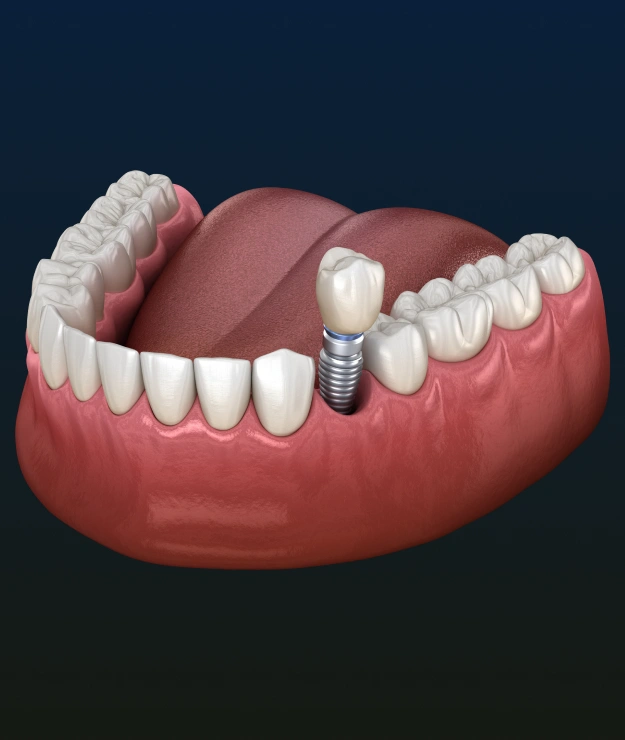
When it comes to replacing a missing tooth, no restoration comes closer to replicating the look, feel, and function of a natural tooth than a dental implant. While bridges and dentures sit above the gum line and rely on surrounding teeth or tissue for support, a dental implant goes one step further, replacing not just the visible crown of the tooth, but the root beneath it as well.
A dental implant is a small titanium post that is surgically placed into the jawbone, where it fuses with the surrounding bone over a period of months in a process called osseointegration. Once fully integrated, the implant becomes a permanent part of your jaw, providing a stable, root-like foundation onto which a natural-looking crown is attached. The result is a restoration that looks, feels, bites, and functions exactly like a natural tooth and with proper care, it can last a lifetime.
At Cariboo Choice Dental, we offer comprehensive dental implant consultations, open 7 days a week, 8 AM to 8 PM, with no waiting lists and same-day consultations available whenever possible.
Book Your Implant Consultation Today
What Is a Dental Implant?
A dental implant is a three-part tooth replacement system that works together to recreate the complete structure of a natural tooth, from root to crown:
-
The Implant Post
The implant itself is a small, threaded titanium post, typically 3 to 5 millimetres in diameter and 8 to 16 millimetres in length, that is surgically placed into the jawbone at the site of the missing tooth. Titanium is used because of its exceptional biocompatibility. The human body accepts it readily, and over a period of 3 to 6 months, the surrounding bone tissue grows directly onto and around the implant surface in a process called osseointegration. Once this process is complete, the implant is permanently anchored in the jaw, as stable and secure as a natural tooth root. -
The Abutment
Once the implant has fully integrated with the jawbone, a small connector piece, called an abutment, is attached to the top of the implant post. The abutment protrudes slightly above the gum line and serves as the connection point between the implant and the visible crown. In some cases, the implant post and abutment are a single unit. In others, they are placed separately. -
The Crown
The final component is the dental crown, the visible, tooth-coloured restoration that sits above the gum line and recreates the natural appearance and function of the missing tooth. The crown is custom-fabricated from impressions of your mouth and carefully shade-matched to blend seamlessly with your surrounding natural teeth. It is attached to the abutment either with dental cement or a small retaining screw.
Together, these three components create a complete, permanent, and natural-looking tooth replacement that functions in every way like the tooth it replaces.
Types of Dental Implants — Options for Every Situation
Dental implants are not limited to replacing a single tooth. They can be used to support a variety of restorations depending on the number of teeth missing and the patient's individual needs and preferences:
Single Tooth Implant
The most common implant restoration, a single implant post topped with a single custom crown, used to replace one missing tooth. A single implant is entirely self-supporting and does not affect or involve the adjacent teeth in any way, making it the most conservative and tooth-preserving option for replacing a single missing tooth.
Implant-Supported Bridge
When two or more consecutive teeth are missing, an implant-supported bridge uses two implants, one at each end of the gap, to support one or more pontics (artificial teeth) in between. This avoids the need to place an implant for every missing tooth while providing stable, fixed support that does not rely on natural teeth as anchors.
Implant-Supported Partial Denture
For patients with multiple missing teeth in different areas of the arch, a partial denture anchored to strategically placed implants provides significantly improved stability and retention compared to a conventional removable partial, without requiring the preparation of adjacent natural teeth.
Implant-Supported Full Denture (Overdenture)
For patients missing all teeth in an arch, a full denture can be anchored to a series of implants, typically two to four for a lower arch and four to six for an upper arch. The implants snap or clip onto the underside of the denture, providing dramatically improved stability, comfort, and chewing function compared to a conventional removable full denture.
All-on-4 / Fixed Full-Arch Implant Bridge
The All-on-4 uses four strategically placed implants to support a complete fixed arch of teeth. Unlike an implant-supported overdenture, a fixed full-arch bridge is permanently attached to the implants and cannot be removed, providing the closest possible experience to having a full set of natural teeth. This option is particularly well-suited to patients who have lost all teeth in an arch and want a completely fixed, non-removable solution.
Our dentist will discuss the most appropriate implant restoration for your specific situation at your consultation, taking into account the number and location of missing teeth, the volume and quality of available bone, your overall health, your lifestyle, and your goals.
The Dental Implant Process
The dental implant process is a multi-stage journey that unfolds over several months but the result is a permanent, lifetime restoration that makes every step worthwhile. Here is a clear overview of what to expect:
Initial Consultation and Assessment
Your implant journey begins with a comprehensive consultation at Cariboo Choice Dental. Our dentist will examine the implant site, review your dental and medical history, assess your gum health, and evaluate the volume and density of the available bone. X-rays and, in some cases, a CT scan are used to give a detailed three-dimensional picture of the bone at the implant site. Based on these findings, our dentist will confirm whether you are a suitable candidate and discuss the recommended treatment plan, timeline, and costs in full.
Implant Placement Surgery
The implant placement procedure is performed under local anaesthetic, and for patients who experience significant dental anxiety, sedation options may be discussed. A small incision is made in the gum tissue to expose the underlying bone, and a precisely sized channel is created in the bone using a series of specially designed drills. The titanium implant post is then carefully placed into this channel and the gum tissue is closed around it.
Following placement, the implant enters the osseointegration phase, a period of typically 3 to 6 months during which the surrounding bone tissue grows onto and fuses with the implant surface. During this period, a temporary restoration may be placed to maintain appearance and function at the implant site.
Abutment Placement
Once osseointegration is confirmed, typically through a clinical examination and X-ray, the abutment is attached to the top of the integrated implant post. In some cases, this involves a minor surgical procedure to reopen the gum tissue. In others, the abutment can be attached without further surgery. A healing period of 2 to 6 weeks follows to allow the gum tissue to heal and shape around the abutment.
Final Crown Fabrication and Placement
Detailed impressions of the abutment and surrounding teeth are taken and sent to a dental laboratory, where your custom crown is fabricated to precise specifications, carefully matched in colour, shape, and size to your natural teeth. When the crown is ready, it is attached to the abutment, either cemented permanently or secured with a small retaining screw, and the bite is carefully adjusted to ensure complete comfort and function.
Ongoing Maintenance
Once your implant crown is in place, regular dental check-ups and professional cleanings are essential to maintain the health of the implant and the surrounding tissue. Our team will monitor the implant, the crown, and the gum tissue at every visit, ensuring your implant remains healthy and functional for the long term.
Are You a Candidate for Dental Implants?
Dental implants are suitable for the vast majority of adults who are missing one or more teeth but a thorough assessment is essential to confirm suitability before treatment begins. Here are the key factors our dentist evaluates when assessing implant candidacy:
- Adequate Jawbone – Sufficient bone is needed to support the implant; bone grafting may be recommended if bone loss has occurred.
- Healthy Gums – Any active gum disease must be treated before implant placement.
- Good Overall Health – Certain medical conditions and medications can affect healing and implant success.
- Non-Smoker or Willing to Quit – Smoking increases the risk of implant complications and failure.
- Completed Jaw Growth – Implants are typically placed only after jaw development is complete.
- Commitment to Oral Care – Good oral hygiene and regular dental visits are essential for long-term implant success.
Ready to Explore Dental Implants in Williams Lake? Let's Talk
Dental implants are a lifetime investment in your smile, your health, and your quality of life. At Cariboo Choice Dental, we offer comprehensive, pressure-free implant consultations with same-day appointments available, no waiting lists, and extended hours 7 days a week, 8 AM–8 PM. New patients receive a FREE $25 Gift Card on their first visit.
Book Your Implant Consultation Today
Frequently Asked Questions About Dental Implants
New Patients & Emergency Appointments Welcome!